


Chef’s Notes
Mason Bostwick · Executive Chef
Eastern oyster
Moonstone — Moonstone — Strong minerality — nutty and stone mineral finish. A solid farmed eastern oyster.
Flavor chart
Chef palate read
Shuckability
Shell & line performance
When I buy it
Look for Moonstone Oysters in peak season when salinity peaks.
How I serve it
On the half shell with minimal garnish — let the oyster speak.
What to watch for
Full brine with clean finish. Reject any with broken shells or milky liquor.
My read
Strong minerality — nutty and stone mineral finish. A solid farmed eastern oyster.
Moonstone oyster farmers cultivate these Atlantic oysters in Point Judith Pond on the Rhode. Island coast just south of Narragansett Bay. East Coast restaurants and New Englanders highly favor their deep cups and full-bodied flavor. Moonstone oysters are part of Rhode Island’s Blue Economy promoting sustainable ocean resource use.
That program supports economic growth, improved livelihoods, and jobs across the state. It also preserves the health of the ocean ecosystem while expanding farm output. Wholesalers and raw bars list the line from Providence to Boston when Rhode Island stock is available.
What Are Moonstone Oysters?
Moonstone Oysters are farmed Eastern oysters from Point Judith Pond on the Rhode Island coast. The stock is Crassostrea virginica, the classic Atlantic Eastern oyster. John and Cindy West’s family operation raises the line in Point Judith Salt Pond south of Narragansett Bay. Distributors and raw bars across New England list Moonstone on tags and menus.
Growers use floating rack-and-bag culture in mesh cages about one to two feet off the pond bottom. Shells show beautiful white exteriors with black markings typical of Point Judith eastern stock. Deep cups and large shells average about 3.25 inches with plump meats. Bottom clay conditioning after rack-and-bag grow-out builds the meaty texture Rhode Island buyers expect.
On the half shell the line reads Nutty + Stone mineral finish with salinity near 28–32 ppt. Flavor opens with intense, full-bodied brine that reads bold on the palate. Mid-palate turns nutty with a stone-mineral backbone rather than heavy cream. The finish lingers tannic and mineral — a solid Rhode Island eastern oyster for minimal-garnish service.
How Did Moonstone Oysters Get Their Name?
Moonstone Oysters take their trade name from the West family brand in Rhode Island. Buyers see the Moonstone label on tags and distributor manifests across the Northeast. The name marks farmed eastern oysters from Point Judith Pond south of Narragansett Bay. Chefs and wholesalers list the line on raw-bar menus year-round.
Beautiful white shells with black markings may evoke moonstone gems with similar pale, luminous tones. That visual cue helps buyers recognize the Rhode Island line at a glance. John and Cindy West own the Point Judith Salt Pond farm that carries the brand. Their family name sits behind each harvest lot shipped to seafood partners.
About the farm
Moonstone oysters come from a farm owned by John and Cindy West and operated by the West family. It is located in Point Judith Salt Pond, Rhode Island. The oysters are raised in Point Judith Pond and finished in the rich bottom clay.
The farm is on the Rhode Island coast just south of Narragansett Bay. Several generations of the West family continue farming oysters in Point Judith Pond. The farm’s core values are stewardship and sustainability.
About the Farm
Moonstone oysters grow using the rack and bag method in Point Judith Pond. Growers float mesh cages or bags about one to two feet off the pond bottom during grow-out. Farmers finish stock on the rich clay at the natural sea floor before harvest. Bottom culture on that clay sets the meaty texture Rhode Island buyers expect.
John and Cindy West operate the family farm in Point Judith Salt Pond on the Rhode Island coast. Several generations of the West family continue farming oysters in the pond south of Narragansett Bay. Fortune Fish & Gourmet power-washes shells to strengthen and clean them before market lots ship. The farm’s core values are stewardship and sustainability.
Moonstone oysters are part of Rhode Island’s Blue Economy promoting sustainable ocean resource use. East Coast restaurants and New England buyers favor the line for deep cups and full-bodied flavor. Seasonality runs from February through December with year-round tags on many distributor lists. J.J. McDonnell and Ocean State Shellfish Cooperative harvest and sell the line regionally.
Moonstone Oysters Information

Eastern oyster
If you like Moonstone Oysters, then check out these similar varieties!
Oyster: Moonstone
Cultivation Method: Cultivated using the rack and bag method. This method involves growing oysters in mesh cages or bags that float about one to two feet off the bottom of the pond
Seasonality: Feb- Dec.
Size: 3.25″+
Culture Method: Bottom culture method uses the natural sea floor as the base.The rich clay at the bottom of Point Judith Pond sets the oysters.
Salinity: 28 – 32 ppt
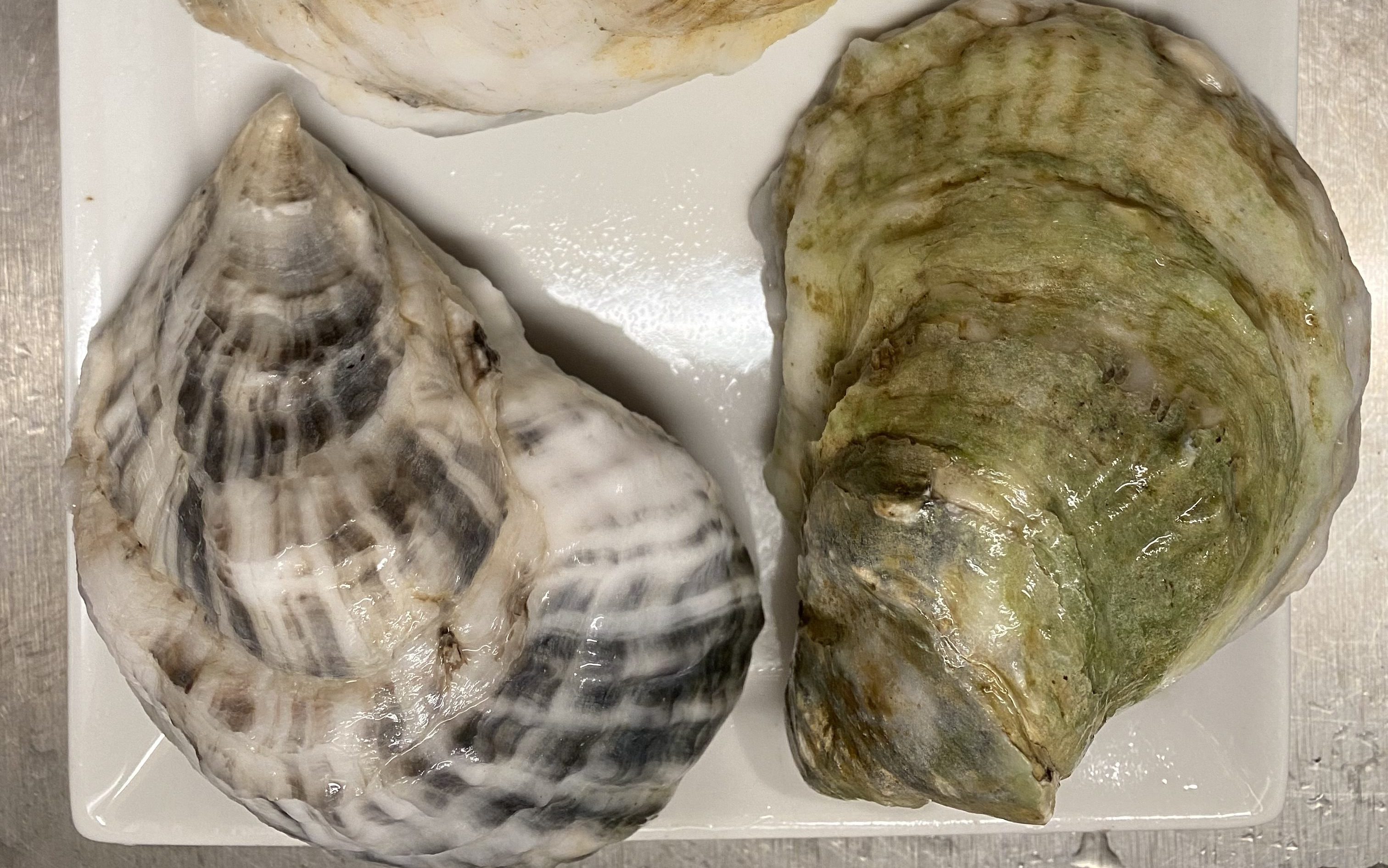
Appearance: Beautiful white shells with black markings. They are known for their deep cups and large size, with an average size of 3.25 inches. The oysters have plump meat and meaty texture
Flavor Profile: They have an intense, full-bodied brine start and a lingering nutty tannic finish.
Location
Moonstone oysters grow in Point Judith Pond on the Rhode Island coast south of Narragansett Bay. The pond sits near Point Judith in Narragansett, Rhode Island, United States. Map coordinates place the farm neighborhood at latitude 41.36538 and longitude -71.486723. Salinity runs about 28 to 32 ppt across much of the lease area.
Point Judith Salt Pond opens toward Rhode Island Sound through tidal channels that flush farm gear daily. Rack-and-bag cages float in the upper water column during grow-out. Farmers then set stock on rich bottom clay that deepens cups and firms meats. This two-step rhythm shapes the bold brine buyers know.
East Coast restaurants and New England wholesalers source Moonstone from this Narragansett shoreline. J.J. McDonnell, Ocean State Shellfish Cooperative, and Fortune Fish & Gourmet distribute the line regionally. Visitors driving the coastal south shore pass Point Judith on the way to farm country. They are in Point Judith Pond, on the Rhode Island coast just south of Narragansett Bay.
Suggested Beverage Pairings
Domaine de la Pépière Muscadet brings high acidity beside Moonstone briny flavor. Classic Loire white remains a popular pairing for these cups.
William Fèvre Chablis offers mineral sea-breeze character beside Moonstone briny cups. Burgundy Chardonnay complements Atlantic half-shell salinity.
Veuve Clicquot Brut Yellow Label brings yeasty bready depth beside Moonstone briny cups. Classic Champagne effervescence complements oyster flavor.
Famille Perrin Viognier from France offers floral fruit beside Moonstone cups. Rich aromatic white provides excellent alternative to classic sparkling pairings.
The Old King Cole Martini brings gin botanicals beside Moonstone briny flavor. Olive saltiness creates savory contrast on half-shell presentation.
Where Can I Buy Moonstone Oysters?
Moonstone oysters are sold by a variety of retailers and seafood partners.
- J.J. McDonnell: J.J. McDonnell is a seafood partner that sells oysters. They offer nice, large oysters from Point Judith Pond, RI.
- Ocean State Shellfish Cooperative: The Ocean State Shellfish Cooperative harvests Moonstone oysters from Point Judith Pond in Rhode Island and sells them.
- Fortune Fish & Gourmet: Fortune Fish & Gourmet sells Moonstone oysters that are power-washed to strengthen and clean the shells.
References
- J.J. McDonnell:. Web. Accessed 30 May 2026. https://www.jjmcdonnell.com/oysters-at-j-j/moonstone-2
- Ocean State Shellfish Cooperative:. Web. Accessed 30 May 2026. https://www.oceanstateoysters.com/the-oysters
- Fortune Fish & Gourmet. Web. Accessed 30 May 2026. https://www.fortunefishco.net/moonstone
Discover more from The Oyster Encyclopedia
Subscribe to get the latest posts sent to your email.