


Let’s explore the various oyster species found in different habitats around the world, focusing on the few that are common food sources. We’ll learn about their unique characteristics and where they are from. From the Olympia oyster, which is native to the Pacific coast of North America, to the newly described species from Southeast Asia, each oyster species has its own story to tell. So, let’s explore the world of oyster species and discover what makes them so special! In this article, we will cover the following topics:
People have enjoyed oysters as a beloved seafood delicacy for centuries. Although there are over 200 species of oysters worldwide, only a few are commonly consumed as food. Let’s explore the five most common oyster species that people consume in the United States and introduce you to the other 195 species you may not have heard of. From the distinctive flavor of the Eastern oyster to the mild and slightly sweet taste of the Olympia oyster, each species has its own unique characteristics that make it a favorite among oyster lovers. So, let’s dive in and discover the world of oysters!
- The five most common oyster species consumed as food in the United States
- Other oyster species found around the world
- Unique characteristics of different oyster species
- Habitat and distribution of oyster species
- Importance of oyster species in the ecosystem
The 5 Most Common Species Of Oysters
1. Pacific Oyster (Crassostrea gigas)
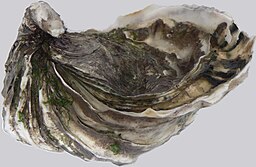
- Appearance: The Pacific oyster is the largest oyster species, with a shell that can grow up to 12 inches in diameter. The shell is usually gray or brown, and the inside of the shell is white.
- Taste: The Pacific oyster has a briny and metallic taste, with a hint of sweetness.
- Gender: The Pacific oyster can change its gender from male to female, and vice versa.
- Distribution, Population, and Habitat: The Pacific oyster is native to Japan’s Pacific coast, but has been introduced to other parts of the world, including North America, Europe, and Australia. It is the most widely cultivated oyster species in the world.
- Conservation status: The Pacific oyster is not considered endangered or threatened.
Pacific Oyster (Crassostrea gigas)- David.Monniaux, CC BY-SA 3.0 http://creativecommons.org/licenses/by-sa/3.0/, via Wikimedia Commons
2. Eastern Oyster (Crassostrea virginica)
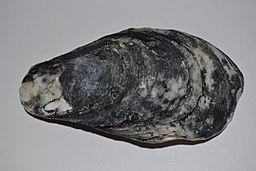
- Appearance: The Atlantic oyster is smaller than the Pacific oyster, with a shell that can grow up to 6 inches in diameter. The shell is usually gray or brown, and the inside of the shell is white.
- Taste: The Atlantic oyster has a sweet and mild flavor.
- Gender: The Atlantic oyster can change its gender from male to female, and vice versa.
- Distribution, Population, and Habitat: The Atlantic oyster is native to the Atlantic coast of North America, from Maine to Florida. It is the most abundant oyster species in North America.
- Conservation status: The Atlantic oyster is not considered endangered or threatened, but some populations are declining due to overfishing and habitat loss.
Atlantic Oyster (Crassostrea virginica)- Andrew C, CC BY 2.0 https://creativecommons.org/licenses/by/2.0, via Wikimedia Commons
3. Kumamoto Oyster (Crassostrea sikamea)
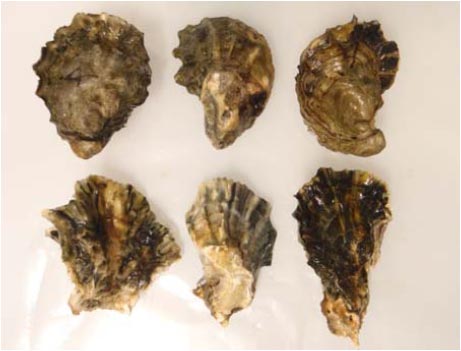
- Appearance: The Kumamoto oyster is similar in size to the Pacific oyster, with a shell that can grow up to 10 inches in diameter. The shell is usually white or cream-colored, and the inside of the shell is orange.
- Taste: The Kumamoto oyster has a mild and sweet flavor, with a hint of cucumber.
- Gender: The Kumamoto oyster is a male or female oyster.
- Distribution, Population, and Habitat: The Kumamoto oyster is native to Japan’s Pacific coast, but has been introduced to other parts of the world, including North America. It is a popular oyster species in California.
- Conservation status: The Kumamoto oyster is not considered endangered or threatened.
Kumamoto Oyster (Crassostrea sikamea)- Japan Fisheries Research and Education Agency
15F Queen’s Tower B, 2-3-3 Minato Mirai, Nishi-ku, Yokohama, Kanagawa, JAPAN 220-6115
4. Olympia Oyster (Ostrea lurida)
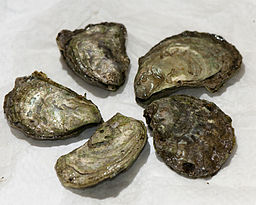
- Appearance: The Olympia oyster is the smallest oyster species, with a shell that can grow up to 3 inches in diameter. The shell is usually gray or brown, and the inside of the shell is white.
- Taste: The Olympia oyster has a briny and minerally flavor, with a hint of sweetness.
- Gender: The Olympia oyster is a male or female oyster.
- Distribution, Population, and Habitat: The Olympia oyster is native to the Pacific coast of North America, from Alaska to California. It is a threatened species due to overfishing and habitat loss.
Olympia Oyster (Ostrea lurida)- VIUDeepBay, CC BY 2.0 https://creativecommons.org/licenses/by/2.0, via Wikimedia Commons
5. European Flat Oyster (Ostrea edulis)

- Appearance: The European flat oyster is similar in size to the Atlantic oyster, with a shell that can grow up to 6 inches in diameter. The shell is usually flat and oval-shaped, and the inside of the shell is white.
- Taste: The European flat oyster has a sweet and delicate flavor.
- Gender: The European flat oyster is a male or female oyster.
- Distribution, Population, and Habitat: The European flat oyster is native to Europe, but has been introduced to other parts of the world, including North America. It is a popular oyster species in France.
- Conservation status: The European flat oyster is not considered endangered or threatened, but some populations are declining due to overfishing and pollution.
European Flat Oyster (Ostrea edulis)- Ryan Hodnett, CC BY-SA 4.0 https://creativecommons.org/licenses/by-sa/4.0, via Wikimedia Commons
For the Sake of Our Readers and This Article
Like we stated earlier, there are over 200 species of oysters in the world, and it would be impossible to go into detail about all of them in this article. However, we have included infographic references to the lineage of many of the most common and interesting oyster species. We hope that this will give you a better appreciation for the diversity of oysters and help you to choose the right oyster for your taste.
Other Species of Oysters You Haven’t Heard Of
Yes, there are over 200 species of oysters in the world, the number is probally closer to 300 currently, because we discover new species frequently. The exact number is not known, as scientists are still discovering new species. The most common oyster species are the Pacific oyster (Crassostrea gigas), the Atlantic oyster (Crassostrea virginica), and the Kumamoto oyster (Crassostrea sikamea). However, there are many other species of oysters, some of which are quite rare.

Creative Commons Attribution License, Daniele Salvi, 1 , * Armando Macali, 2 and Paolo Mariottini 2 Valerio Ketmaier, Editor
The diversity of oyster species is due to the fact that oysters can live in a wide variety of habitats, from shallow coastal waters to deep ocean trenches. They can also tolerate a wide range of temperatures and salinities. This has allowed oysters to evolve into a wide variety of shapes and sizes, each adapted to its own specific environment.
The diversity of oyster species is also important for the environment. Oysters play a vital role in the marine ecosystem, filtering water and providing habitat for other marine life. They also help to stabilize shorelines and prevent erosion.
Different Oyster Types
- Belon Oyster (Ostrea edulis flatauensis): This rare oyster is native to the northern Atlantic coast of France. It has a delicate and sweet flavor, and is one of the finest oysters in the world.
- Blue Point Oyster (Crassostrea virginica bellicosus): This oyster is native to Long Island Sound in New York. It has a briny, Mineral flavor, and is famous for its plump and juicy texture.
- Malpeque Oyster (Crassostrea virginica malpequeensis): This oyster is native to Prince Edward Island in Canada. It has a sweet and delicate flavor, and is large in size.
- Gloucester Rock Oyster (Crassostrea virginica concentrica): This oyster is native to the coast of Massachusetts. It has a briny and minerally flavor, and is known for its firm and meaty texture.
- Kiwa Oyster (Ostrea kincaidii): This oyster is native to New Zealand. It has a sweet and delicate flavor, and is popular for its smooth and creamy texture.
- Sydney Rock Oyster (Saccostrea glomerata): This oyster is native to Australia. It has a strong minerality, and is large with its tradmark smooth shell.
- Foster’s Striped Oyster (Crassostrea gigas fosteri): This oyster is a hybrid of the Pacific oyster and the European flat oyster. It has a sweet and delicate flavor, and is known for its striped shell.
- Hog Island Olympia Oyster (Ostrea lurida hogislandicus): This oyster is a strain of the Olympia oyster that is native to Hog Island in California. It has a briny and minerally flavor, and is known for its small size and delicate texture.
- Ziraffa Oyster (Crassostrea gigas tsugarensis): This oyster is native to Japan. It has a sweet and delicate flavor, and is known for its large size and distinctive shell shape.
Even More Types of Oysters
First and foremost, I want to give praise to the individuals that completed this research below. This information is hard to come by, so thank you!
Liu, Olivia & Hick, Paul & Whittington, Richard. (2023). The Resistance to Lethal Challenge with Ostreid herpesvirus-1 of Pacific Oysters (Crassostrea gigas) Previously Exposed to This Virus. Viruses. 15. 1706. 10.3390/v15081706.


Discover more from The Oyster Encyclopedia
Subscribe to get the latest posts sent to your email.
Pingback: Imported Oyster Ban? The Explosive Battle That Could Rewrite America’s Seafood Industry - The Oyster Encyclopedia