


The 2026 Urbanna Oyster Festival — Nov 6–7 in Urbanna, Virginia
Urbanna is a small town on Urbanna Creek, just off the Rappahannock River — and once a year it hosts Virginia’s official oyster festival. The 69th Urbanna Oyster Festival runs Friday, November 6 and Saturday, November 7, 2026, drawing roughly 50,000 people to a town that measures itself in blocks. The festival has run since 1957 and was designated the Commonwealth’s official oyster festival in 1988. Admission is free; you pay as you go.
69th Urbanna Oyster Festival — Nov 6–7, 2026
Admission: Free; pay as you go
Fireman’s Parade — Friday 7:00 p.m.
Virginia State Oyster Shucking Contest — Saturday 11:00 a.m.
Festival Parade — Saturday 2:00 p.m.
The weekend’s anchors: the Fireman’s Parade on Friday at 7:00 p.m., the Festival Parade on Saturday at 2:00 p.m., and — the one that matters most at a raw bar — the Virginia State Oyster Shucking Contest on Saturday at 11:00 a.m.
Competition shucking and service shucking are cousins, not twins. The contest rewards a clean, fast open with the oyster presented intact in its liquor. Service adds everything around that open: grading the shell, reading the cup, keeping the liquor where it belongs, and doing it hundreds of times a night without the quality slipping. Watching the state’s best work a contest tray is a masterclass in the first half of that job.
This year also carries a 250th-anniversary theme for the country, and Urbanna’s oyster culture is older than the festival by centuries. The growers below have worked these waters since 1899.
The Raw Bar Bible
A deeper look into oysters, shucking technique, brine, knife choice, and real raw bar workflow — written from a chef’s point of view. Clear, practical, and built from actual service experience.
Rappahannock
Topping, VA
13–17 ppt
Rochambeau
Yorktown, VA
16–22 ppt
Olde Salt
Chincoteague, VA
28–33 ppt
Rappahannock Oysters (13–17 ppt): Start Low
Rappahannock Oyster Company farms its namesake oyster near the mouth of the Rappahannock River at Topping, Virginia, where the river meets the Chesapeake Bay. The water there runs low in salt — 13–17 parts per thousand — and the oyster shows it: deep-cupped, mineral-rich, sweet and buttery, with a clean, crisp finish and an understated saltiness that lets the oyster’s own flavor lead.
The company behind it is a revival story. The Croxton family first claimed Rappahannock River bottom in 1899; cousins Ryan and Travis Croxton restarted the operation in 2001 and planted their first crop in March 2002. The oysters are raised from hatchery seed in off-bottom cages.
Rochambeau Oysters (16–22 ppt): The Bay’s Middle Salt Range

Down the Bay at the mouth of the York River, near Yorktown, the same company grows Rochambeau Oysters in what it calls the Bay’s median salt range — 16–22 parts per thousand. Rochambeaus are the quintessential Bay oyster: sweet and mildly briny, with a clean, crisp finish. If the Rappahannock is the gentle end of Virginia’s range, the Rochambeau is its center — the oyster to hand someone who wants the Bay without a salt punch.
Olde Salt Oysters (28–33 ppt): The Salt End, from Chincoteague
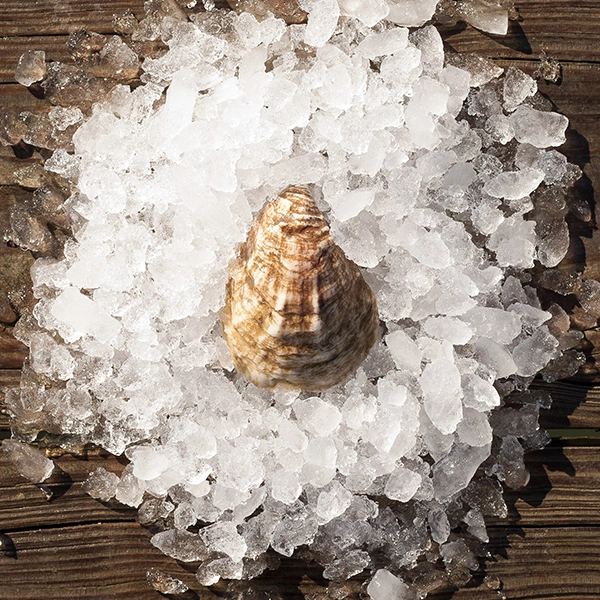
For the full ocean, go east to Chincoteague. The bays and cuts around Chincoteague Island are fed almost exclusively by the Atlantic through Chincoteague Inlet, and Olde Salt Oysters grow at 28–33 parts per thousand — nearly twice the Rappahannock’s salt. The flavor follows the water: bold, seaside brininess with a smooth, clean follow-through. It is the truest taste of the ocean in the company’s lineup, and the right end to a tasting that started upriver.
How to Taste Virginia Oysters at Urbanna: In Salinity Order
That ladder — 13–17, 16–22, 28–33 parts per thousand — is the simplest way to understand Virginia oysters: same species, Crassostrea virginica, three different waters, three different oysters. If you are at Urbanna this year, eat them in that order. And if you want the full entries — flavor notes, where to buy, chef’s notes — they are linked above.
Discover more from The Oyster Encyclopedia
Subscribe to get the latest posts sent to your email.